

What Twenty Countries Taught Me About Responsibility
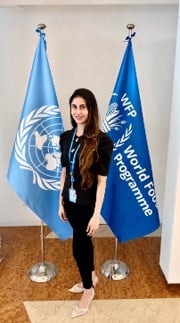
This summer, I had the opportunity to intern with the United Nations World Food Programme (WFP) at its headquarters in Rome, supporting finance and budget allocation across twenty countries spanning Africa, the Middle East and Asia. I came in expecting to learn about budgeting and strategic planning. I left with a much deeper, more personal understanding of what those numbers actually mean.
20 Countries, 20 different realities
My role involved studying the geopolitical and financial situation of each country and helping manage its budget allocation. On paper, that sounds like one repeatable process. In practice, it was anything but. Each country came with its own political tensions, economic constraints, and operational realities, so no two budget conversations ever looked the same.
On top of that came the human side of the work. Coordinating with country offices meant working with different people, cultures and languages, sometimes all within the same week.
Learning to communicate clearly and warmly across those differences, while still moving fast enough to meet real deadlines, was one of the steepest and most rewarding parts of the learning curve.
When a budget line becomes a life
The biggest lesson from this internship had little to do with technical skill. It was the growing realisation that every action I contributed to was connected, however indirectly, to a life in one of these countries. Working at WFP meant sitting closely with intricate data, figures like how many people die of hunger every minute. Reading a statistic like that in a report is one thing. Truly understanding what it represents, and who it represents, is another.
There was a point early on when that realisation truly hit me, and for a week afterwards I found it hard to sit down to a meal without thinking about it. I share that not for effect, but because it captures something real about this internship: it did not just sharpen my analytical skills; it opened my heart in a way I had not expected. It gave me a deeper sense of responsibility, compassion and awareness, and that shift in perspective is the part of this experience I know will stay with me the longest.
Challenge your perspectives and empower your future with the INSEAD one-year MBA programme
Consistently ranked amongst the top one-year MBA programmes in the world by the Financial Times, INSEAD’s full-time one-year MBA programme curriculum develops successful, thoughtful leaders and entrepreneurs who create value for their organisations and their communities.
A team as global as the mission
If the work itself was demanding, the team made it a joy. My teammates were Iraqi, Syrian, Somali, Spanish, Italian, Uruguayan and Filipino, a genuinely global group, and that diversity quickly became one of our biggest strengths. Brainstorming sessions turned into real, generous exchanges of perspective, with each person bringing expertise from a different sector and a different lived experience.
That mix of backgrounds is what let us put together strategic country plans and implementation approaches that were genuinely robust rather than one-dimensional. It is, without question, one of the best and most collaborative teams I have worked with, and it changed how I think about good teamwork. It is not about sameness, but about very different strengths pointed at one shared goal.
Looking back, I think INSEAD prepared me for this more than I realised at the time.
Between Fontainebleau, Singapore and Abu Dhabi, INSEAD's classrooms and study groups are themselves a mix of nationalities, industries, and working styles, and you learn quickly how to build consensus and get things done with people who see problems very differently from you.
Walking into a fast-paced, high-stakes team at WFP, that experience made it feel natural rather than daunting. I was already used to listening across accents, disagreeing constructively and finding the fastest path to a shared answer, and that muscle memory from INSEAD study groups let me settle into the WFP team and its pace far more comfortably than I expected.
Looking back
I came into this internship expecting to learn about budgets and country strategy. I left having learned something far more lasting: that data has faces, that responsibility grows the moment you understand what a decision truly costs or saves and that the best work happens when very different people commit to the same purpose. That is what I will carry forward from my summer at WFP.
This internship experience was supported by the INSEAD Hoffmann Institute Impact Internship Stipend.


