

By Rhoda Yap, Executive Director, INSEAD Career Development Centre | 2 February 2026
Career transitions are often framed as personal journeys—stories of ambition, reinvention and courage. These narratives are compelling and often inspiring, but they rarely tell the whole story. In practice, many stalled or frustrating career transitions do not progress as expected; not because individuals lack talent, motivation, or clarity of purpose, but because effort is often concentrated on the self without a sufficiently structured way of engaging with market realities.
Across global labour markets, highly capable professionals encounter friction as they seek to make moves that appear logical on paper: switching industries, stepping into new functions, or relocating to high-opportunity regions. When progress slows, explanations tend to cluster around two poles. Some interpret the friction as personal—I need to push harder, build more confidence, refine my story. Others externalise it—the market is weak, the timing is unfavourable, or prevailing hiring structures do not easily accommodate non-linear transitions.
Each explanation contains a grain of truth. Yet both miss a more consequential factor: career transitions are shaped not only by individual effort or market conditions, but by how hiring decisions are actually made.
A more effective approach starts by understanding career change not as a purely personal project, but as a market-matching problem.
The good news is that this shift in perspective opens up far more constructive ways forward.
Why strong candidates encounter friction
At experienced professional levels, labour markets do not operate like merit-ranked queues. Employers are not simply selecting the “best” candidate in absolute terms. They are making decisions under uncertainty, with incomplete information, time pressure and risk constraints.
Two well-established insights from labour economics help explain why this matters.
First, labour markets are matching systems, not frictionless competitions. Hiring takes time, information is imperfect, and outcomes depend heavily on timing, availability and constraints. Even highly qualified individuals can remain unmatched—not because opportunities do not exist, but because conditions fail to align at a particular moment.
Second, employers rely on signals—observable indicators such as prior roles, industry background, location, language fluency and work authorisation—to infer future performance. These signals are imperfect, but they reduce risk. As a result, intent and long-term potential often matter less in hiring decisions than signals of immediate effectiveness in adding value to the employer or their customers.
Seen through this lens, friction in a career transition is rarely a definitive judgment on capability.
The INSEAD MATCH Framework: Five questions that shape career outcomes
A market-aware career transition begins by asking a different set of questions—ones grounded in how employers evaluate risk and readiness.
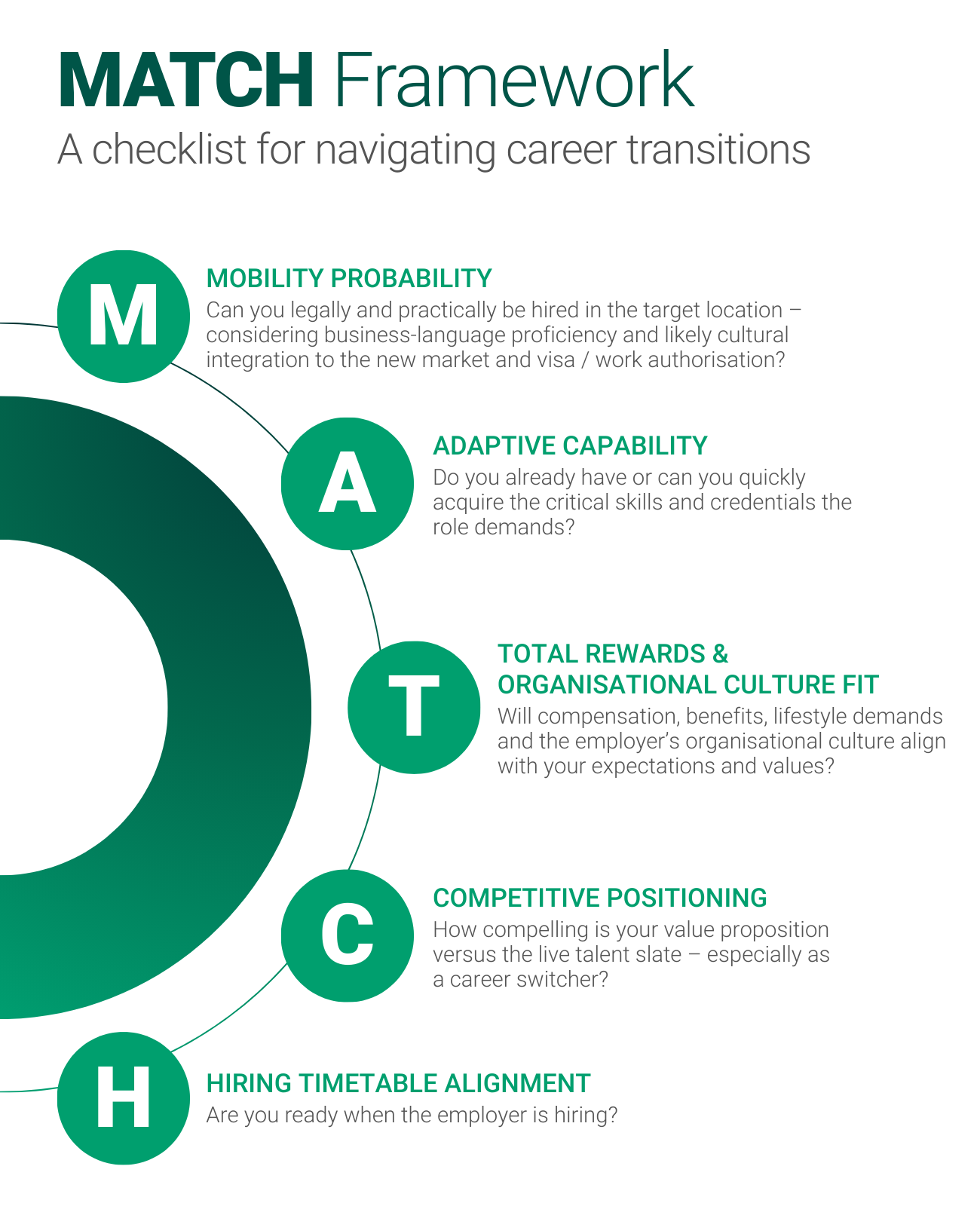
MOBILITY: Can you realistically be hired where you are targeting?
Language proficiency, cultural and market familiarity and the ability to operate credibly in local professional contexts all shape hiring probability. These factors influence how quickly employers believe you can integrate, build trust and be effective. Legal work authorisation also matters—but it is rarely the sole determinant. Many internationally mobile professionals navigate regulatory complexity successfully when other signals of local readiness are strong. What reduces match probability most sharply is not mobility per se, but unresolved uncertainty about whether a candidate can function with confidence and credibility in the target environment.
In globally mobile talent markets, credibility is increasingly built not through long tenure in one system, but through demonstrated ability to operate across languages, cultures and organisational contexts. For many professionals, these signals can be strengthened deliberately over time rather than assumed to be fixed constraints.
ADAPTABILITY: Can you signal readiness to perform quickly?
In most hiring contexts, employers prioritise time-to-productivity. Especially when switching roles or industries, the critical question is not whether you can learn the role, but whether you appear ready to deliver value early. Formal learning experiences—particularly degrees designed around applied problem-solving, exposure to new industries and sustained performance under pressure—can serve as powerful signals of this readiness.
When well-integrated with prior experience, they reduce uncertainty for employers by demonstrating not just capacity to learn, but evidence of rapid adaptation in complex, real-world contexts.
TOTAL REWARDS & CULTURE: Does the role align with your real expectations?
Compensation, lifestyle, pace and organisational culture are often underestimated sources of friction. Misalignment here frequently leads to dissatisfaction or early exit, even when the transition itself succeeds. Therefore, bringing these considerations into the conversation early can help shape more durable and satisfying transitions.
COMPETITIVE POSITIONING: How competitive is your positioning relative to others?
The relevant benchmark is not an abstract standard, but the live talent slate. Employers compare candidates based on how clearly they reduce perceived risk in a specific context—industry, function and location. Profiles that signal familiarity with local norms, stakeholder expectations and operating environments often outperform those that rely on transferable skills alone.
This is why career transitions succeed not simply through capability, but through contextual credibility: the extent to which a candidate already looks like someone who belongs in that market. For professionals, this does not require a perfect match, but a profile that helps employers quickly understand fit and feasibility.
HIRING WINDOWS: Are you ready when employers are hiring?
Some roles follow predictable, cohort-based recruitment cycles. Many others emerge opportunistically through market hiring. Strong candidates will sometimes see opportunities pass by when preparation and market timing are not yet aligned.
Together, these questions shift career strategy away from aspiration alone and toward execution realism.
From frustration to strategic adjustment
When career progress slows, it is tempting to respond by waiting for conditions to improve or by doubling down on effort without changing approach. A market-aware lens offers a third path: more disciplined market sense-making.
Friction is a signal. It indicates where constraints are binding, where signalling is weak, or where timing is misaligned. Interpreted correctly, it enables professionals to adjust positioning, sequence ambition more intelligently and allocate effort where it has the highest marginal impact.
This reframing is powerful. It replaces self-blame and passive waiting with informed agency—without denying the reality of market cycles or structural constraints.
From hope-based moves to market-aware agency
No framework can eliminate uncertainty from career decisions. Hiring will always involve risk, competition and chance. What can change is how deliberately individuals engage with that uncertainty.
Professionals who understand how labour markets function are better equipped to anticipate friction, make informed trade-offs and pursue meaningful transitions with realism and resilience. In volatile global talent markets, this capability is not just useful for the next role—it is a durable career skill that allows ambition to translate into durable progress.
A market-aware lens for career coaching professionals
Career coaching often focuses on identity, motivation and narrative—and rightly so. These elements are essential for meaningful career decisions. Yet many clients struggle not because they lack clarity, but because employer-side decision logic remains implicit.
A market-aware lens complements reflective coaching by making hiring dynamics explicit:
- Employers hire under uncertainty and manage risk through signals
- Timing and competition shape outcomes as much as capability
- Difficulty often indicates misalignment, not personal failure. This distinction is particularly important in preventing unproductive spirals.
This approach underpins how INSEAD’s Career Development Centre works with our students and participants: combining aspiration with rigorous analysis of feasibility, capability, competitiveness and timing. Used ethically and transparently, it helps individuals move from vague goals to market-grounded experimentation—without diminishing autonomy or ambition, whilst reducing procrastination in execution.
Rhoda Yap is the Executive Director of the INSEAD Career Development Centre, where she leads a globally distributed team of over 40 career professionals across four locations and 19 nationalities. With a background spanning multiple careers, including management consulting and law, her work integrates research methods with practitioner insight to examine how labour markets, hiring systems and decision-making under uncertainty shape career outcomes. Her work includes translating empirical evidence into practical frameworks for navigating complex career transitions.


