

Two GEMBA Alumnae, One Mission: Helping Healthcare Leaders speak Fluent AI
Dianne Baunbaek and Joanna Reijgersberg-Siew are INSEAD Global Executive MBA (GEMBA) class of 2019 alumnae. Both teach and write on AI literacy for senior decision-makers in healthcare.
We both lost our fathers to prostate cancer.
That loss shaped the careers we have made in different ways. Dianne spent more than 20 years in healthcare. Her work spanned pharmaceuticals, diagnostics and precision medicine, focused on understanding the origins, diagnostics and treatments of cancer.
Joanna spent 18 years in AI and engineering, a curiosity sparked in childhood and sharpened by a hard truth: the diseases that take the people we love do not wait for science to catch up.
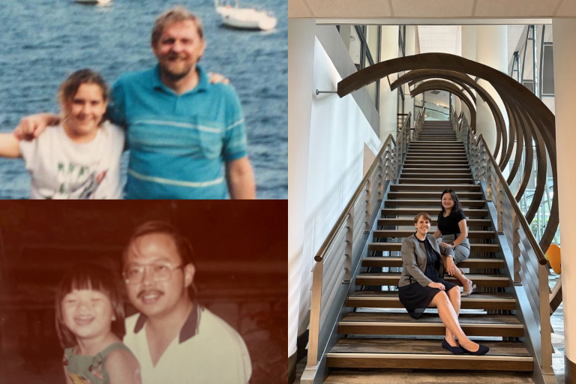
Seven years after graduating from INSEAD Global Executive MBA (GEMBA) together, we have come to a shared view of where the constraint now lies. The technology side of healthcare AI has stopped being the bottleneck. Adoption is happening, fast and unevenly, with or without the conditions that would make it safe. What is missing is the literacy of the people who decide where, how, and on what terms AI enters the care system.
What we have observed
Healthcare AI adoption is moving fast and unevenly. In the US, 81% of physicians now use AI in practice; 27% have received no training at all. In Asia Pacific, fewer than one in ten MedTech professionals possess the dual fluency the sector demands: clinical depth and AI capability in one person. The senior leaders we have spoken to describe the same texture of the problem: too much noise, too many vendors, too many promises, and too little time to separate signal from substance.
These leaders are not failing due to a lack of intelligence or interest. They are operating in a category they were not trained for, against a clock that does not pause for them to learn. The deployment decisions they are making now will shape outcomes for years. These span clinical AI tools, patient-facing language systems, administrative automation, and vendor selection. Many of these decisions are being made faster than the institutional systems around them can govern.
What is striking is that the gap is not technical. The leaders who navigate this well are not the ones who try to become engineers. They are the ones who bring decades of judgment under uncertainty to a new domain, and who develop enough fluency to ask sharper questions of the people building the tools. The skill they need is leadership skill, applied to a category most of them did not encounter in their formative years.
"Lifespan is the wrong metric. Countries should be tracking how well their populations age, not just how long they live. I’ve followed the healthspan debate for years. It changed how I approach my own health and how I train. The science for a healthier life exists. The senior leadership literacy to deploy it well, at scale, does not. Yet. That’s what Cranberry Learn is building."
Professor Claudia Zeisberger
Senior Affiliate Professor, INSEAD Entrepreneurship & Family Enterprise; Founder, Global Private Equity Initiative
The healthspan point is the right frame. The science of better outcomes is moving faster than most healthcare systems can absorb. This is true across cancer, cardiovascular disease, metabolic disease, and ageing itself. AI is part of why. But the absorption depends on whether senior leaders can hold both the capability and the limit in mind at once, and govern accordingly. That is not a one-day workshop’s worth of teaching. It is a different shape of executive education from the one most senior leaders have been offered until now.
A new shape of executive education
This is why the institutional response matters. Senior healthcare leaders cannot pause their roles to retrain. The category is moving too fast for static curricula. What works, in our experience, is sustained, peer-cohort learning that builds vocabulary, frameworks for evaluation, and judgment for governance, taught by people who have built and deployed these systems, not only people who have written about them.
"The leadership gap healthcare AI has surfaced can’t be closed with more modules; it asks executive education to change shape. Translating fast-moving capability into governable judgement is precisely INSEAD’s role, and Singapore is positioned to lead it."
Professor Sameer Hasija
The Henry Ford Chaired Professor in Technology and Operations; Dean of Executive Education and Dean of the Asia Campus, INSEAD
What this means in practice
For senior leaders reading this who are navigating an AI inflexion in their own sector, and most are, the most useful starting point may be to treat AI fluency as part of the leadership job description, not as a technical project to be delegated. The decisions ahead are not going to be made by AI specialists on behalf of leadership. They will be made by leaders, with whatever fluency they bring to the moment.
The patient at the end of every healthcare workflow is somebody’s father, mother, partner or child. The decisions being made now, in policy ministries, in hospital executive teams, in MedTech boardrooms, and in capital allocation committees, will shape outcomes for real people. Like our fathers, every patient deserves care shaped by better judgment, better tools and better-informed leadership.
That is the standard worth working toward. It is also increasingly the standard that senior leaders across every sector will be expected to meet.
Further your potential and redefine the leader in you.
Sources
• AMA, 2026 Physician Survey on Augmented Intelligence (March 2026).
• AMA, “More than 80% of physicians use AI professionally: AMA survey” (March 2026).


