
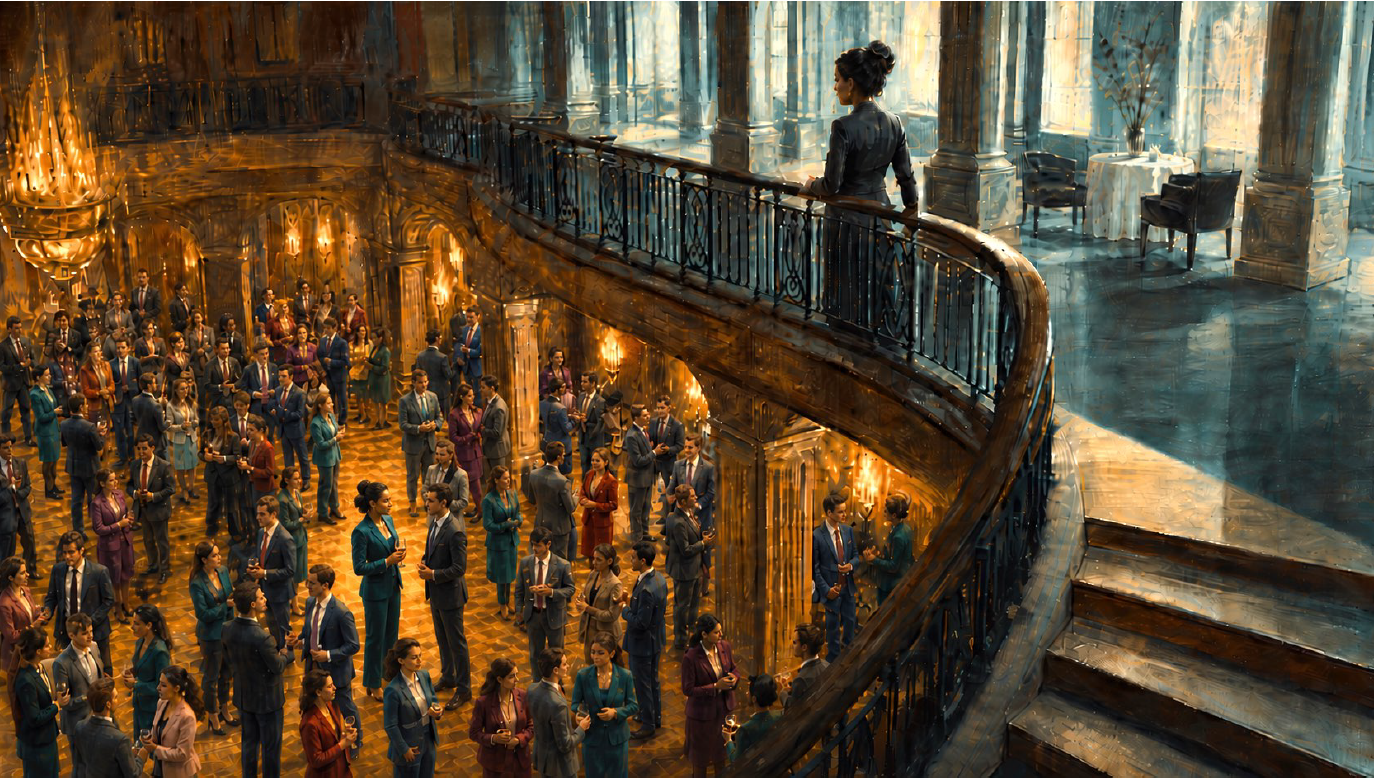
Where Deep Work Meets Shallow Time: Why We Keep Arguing With the Wrong Thing
Most advisors I know carry a private unease. It lives in the gap between what we can see clearly when we are alone with a situation, and what we can actually say once we walk into the room.
Outside the meeting, the pattern is obvious. The avoidance is named, the dynamic is mapped, the unspoken is almost speakable. Inside the meeting, the same pattern goes silent. I hear myself reach for a softer word, a more strategic-sounding metric, a frame that fits the agenda. The room nods. The work does not happen.
by Massimiliano Savarese
May 2026
I have felt this for as long as I have done this work. The first time I noticed it I was sitting in the departures hall at Charles-de-Gaulle, just out of a residential week at INSEAD, my head still full of the language of the unconscious. A client had texted. Quick call tomorrow on the culture diagnostic, we need concrete deliverables. Concrete. Deliverables. None of the words I had been living inside all week seemed to fit that brief.
Not because deliverables do not matter. They do. I have spent most of my career producing them. The trouble with culture work is that what the client calls a deliverable is the visible tip of something larger and slower. The slide, the framework, the heat map. Underneath sits the part that takes time to surface, the part the client often does not want to know about. That afternoon, with the question sitting there unanswered, I did not yet have a way to say so.
I have since collected dozens of versions of the same discomfort. In a steering committee, I noted that the same decision had been returning to the agenda for three months, dressed in slightly different language each time. The COO smiled, closed his notebook, and asked whether we could hit the timeline "without extra psychology." At a dinner, someone asked what I did. I help leadership teams see what they are not seeing. She nodded. So, like a management consultant? Sort of. Not really. I changed the subject. At home, my daughter asked why I was reading a book called Group Relations. It is about how teams get stuck, I said. She shrugged, said "Ah, ok," and asked when dinner was.
Each scene leaves the same aftertaste. Clarity and tongue-tied frustration at once. Anyone who has done this work for any length of time will recognise it instantly, and will also recognise the explanation we reach for: they don't get it, or, on the worse nights, I don't get it well enough. Both are wrong. The pushback is doing something. We have spent too long arguing with it instead of standing in it.
Why do the most important conversations in an organisation, the ones about fear, rivalry, purpose, go silent the moment a deadline appears? Why do we still pretend the room can be made rational by closing the door on what is actually happening inside it? On good days I blamed the room. On bad days I blamed myself. Both wrong.
The pushback we meet is partly the system doing its job, and partly the system reading us correctly: the advisor walks in carrying his own anxiety and has not yet learned to separate it from theirs.
That is what 27 years inside organisations, and two more at INSEAD putting words to what I had been doing on instinct, taught me about the gap. It is not a method. It is a reckoning that has not finished.
The line that keeps me honest
One of my most distinguished professors at INSEAD opened a session with a sentence I have not been able to put down since. Every time you want to be of service, to an organisation, to an individual, you have to be able to separate your sh*t from their sh*t. The room laughed. He waited. Then he said it again, more slowly, because the laughter was the proof.
I used to think this was the whole job. It is not. It is the prerequisite, the part you cannot skip. You walk into a room as an advisor and you bring your own fears, your patterns, your unfinished business. So does everyone else, and so does the room itself. If you cannot tell which is yours and which is theirs, you spend the meeting solving the wrong problem. You think the team is anxious when it is you who is anxious. You think the leader is being difficult when he is doing exactly what his role requires. You mistake your discomfort for their resistance, and their resistance for your inadequacy. Both errors at once, sometimes in the same meeting.
Separating is what lets you step off the dance floor, see what is actually being danced, and step back on without losing the rhythm. Most of us are reasonably well-trained at watching organisations. We are far less well trained at watching ourselves while we watch them. That is the claim of this piece. The room is not the problem. We are not the problem either. The work happens at the joint where the two meet, and many of us, myself included, spend years arguing with the joint instead of standing in it.
What the room is actually doing
If resistance is doing organisational work, it is worth asking what the work is. What follows comes from many years of meetings, several conversations with senior practitioners I respect, and the kind of hindsight that only earns itself the hard way. My mistakes, in other words.
A room has two primary tasks, and only one is speakable. The official task of an executive meeting is to make decisions. The unofficial one is to manage the anxiety produced by the decisions the group cannot make.
We arrive offering to help with the second. The second is not in the contract, not on the agenda, not in the org chart. So everything we say about it gets translated back into the language of the first, where it sounds tangential.
I learned this in a one-on-one with a CEO I had worked with for months. The agenda was a quarterly review of deliverables. 40 minutes in, after I had walked him through the design work, the analytics, the proposed interventions, he leaned forward. "What is this plan? Where is it going to take me?" I started to answer with content. He cut in. "What will I achieve from it?" The official conversation was about deliverables. The actual conversation, for anyone listening, was about whether he believed the function I was building would protect him. The plan was the surface. The anxiety was the work. When I tried to make the second task speakable, the room did not refuse me. It politely returned to the first. That is not a failure of communication. It is how organisations talk about themselves. The job, on a good day, is to hold the lid open for thirty minutes before the system has to defend itself against the exposure.
Then there is the role itself, which is a social defence before it is a person. Senior leaders are hired to absorb anxiety and project conviction. The seat is a containing function for the whole system. So when we invite a CEO to get curious about his own contribution to a dynamic, we are asking him to step out of the function the system assigned him, and the system, not just the man, resists.
I sat once across from a CEO who told me, in a moment that was neither cruel nor irrational, "I don't need believers. I do not need to recruit people to change for me. I already have you." For months, I read that line as personal. As control. As him not letting me in. I was wrong. The role was speaking. The institution had hired him to absorb anxiety on its behalf, and he was doing precisely that, including with me. The line was not a closed door. It was the door doing what doors are paid to do. That reading is sharper than leaders are defensive, because it tells you the resistance is doing organisational work, and it tells you where to push. Do not ask the leader to drop the role. Ask him to inspect it from the inside.
The harder fact underneath both scenes is that the pain is in the system, but the contract is with an individual. A leader calls because he is uncomfortable, and his discomfort is almost always a system-level signal.
Work on him, and you mislocate the problem and produce a well-coached executive in an unchanged system. Work on the system, and you exceed the contract and trip every boundary defence in the organisation.
Most engagements never resolve this. The skill is to work at the edge of the contract without breaching it, and to renegotiate it slowly as trust accrues. I have not always managed it. The pull is to treat the leader as the patient, when the patient is the room. The temptation is enormous, partly because his discomfort is what got us hired, and partly because the system-level work is harder, slower, and far less grateful.
And all of this happens on the wrong clock. We are selling deceleration in an acceleration economy. Between client calls, I keep a small trading dashboard open, just enough to scratch the itch of a new hobby. One click shifts the chart from five-minute candles to daily bars to weekly timelines. Same stock, three different worlds. On the five-minute view, the screen jerks with every headline; patterns that look urgent at 10:05 are gone by the afternoon call. Zoom out to daily and the noise settles into arcs. Go weekly and a different story appears entirely, the one made of strategy shifts and cultural resets and leadership changes, forces that barely register to the scalper but decide the share price over quarters.
This kind of work belongs on the daily-to-weekly horizon. The rooms we enter vibrate at five-minute cadence. Slack pings, KPI dashboards, stock-price popups. When we ask a board to look at the longer chart, they hear us asking them to violate a fiduciary commitment. We have not yet made the case, persuasively, that slowing down in a few key places buys speed in decision quality everywhere else. Until we do, the resistance is rational. It is not weather to wait out. It is a partner already moving.
There is a last thing the room is protecting, and it is the most personal. Our work threatens the autobiography that got them the job.
Senior leaders rose on a story. I got here because I am rational, decisive, capable, in control. The work I do quietly suggests that decisions are shaped in part by forces they did not choose and cannot fully see. We are asking them to revise the very story they used to climb.
I have heard that autobiography in many forms, never more plainly than from a CEO who said, in a single conversation, "I am a very structured person. I am not going to wait for anybody. Strategy is created inside the institution. I do not wait for people from outside to come and do it for me." Read one way, that is a leader being controlling. Read another way, it is an autobiography defending itself. The story that got her the seat is the story she has to keep telling, every day, in order to perform the seat. Inviting her to revise it is not a small ask. It is asking her to dismantle the identity the role requires her to perform before lunch, and again after it. Some leaders can do this. Many cannot, not from limitation, but because the revision would take down the daily performance the system is paying for.
The thing that is on us
Five readings of the room. Here is one more, and it is not about the room. It is about us, the ones who do this work, and it is the one I find hardest to write.
I have watched it in colleagues and I have watched it in myself. The advisor who has spent years building a sophisticated reading of organisational life walks into a room, reaches for the new vocabulary, and the room closes. The advisor who has not yet acquired that vocabulary walks into the same room with instinct alone, and the room stays open. The very language that lets us see them can be the language they cannot hear.
I can name the meeting where this stopped being abstract. The question on the table was whether the executive committee could be held accountable for the soft side of leadership. I was making the case, drawing on exactly the vocabulary I had spent the previous years deepening, that the responsibility belonged on the whole team's plate and not only the CHRO's. The CEO held his ground. This is HR. You cannot put it on the executive committee. They operate in a system. I pushed back. He did not move. I pushed harder. The room closed.
The version of me who knew less, twenty years earlier, would have heard that moment differently. He would have taken "this is HR" not as a refusal but as a clue. The role the CEO was being asked to play right then did not let him say yes; the role was holding a line, which is what the institution paid it to do. Pushing harder was the wrong move. Sitting with what the CEO was protecting was the right one. The earlier me knew that in his body, without the words. The later me had the words, reached for them, and lost the room the younger man would have stayed inside. The training had given me sight and cost me touch.
This is the part that is on us, not on the room. The field has spent a generation learning to read the unconscious of organisations. We have spent far less time reading what we ourselves are doing inside them. The resistance we meet is partly the system's, and partly the system's accurate read of an advisor who has acquired a sophisticated language and not yet learned to use it without losing what was already working.
The professor's line was the warning all along. Separate your sh*t from their sh*t. He did not offer it as wisdom. He offered it as the prerequisite. Get it wrong and the work cannot begin. Get it right, sometimes, and the room stays open long enough for something true to happen. I am still learning the difference. Most days I find I am not as good at the separating as I thought, and I have come to believe that is the field's actual condition, not only mine.
What changes
The unease I started with does not go away. I felt it again last month, walking out of a meeting where the leader had performed his role exactly as the system needed, and where I had reached, once more, for the wrong tool.
For a long time, I thought the goal was to close the gap. Find the right phrase, the right metric, the right entry point, and it would settle. It does not settle. It is the gap, and the gap is where the work lives.
What changes is what we do with it. I no longer treat the room as the obstacle. I treat the resistance as a partner already in motion, and the only question worth asking is whether I can move with the rhythm it is in, or whether I need to step off the floor for a moment to see what is actually being danced. So I ask, before anything else, what is this person being paid to hold right now, and will what I am about to say make it harder or easier for him to keep holding it. Sometimes the move is to translate. Sometimes it is to stay quiet. Sometimes it is to wait three meetings until the system can metabolise what I want to put on the table. None of that is technique. It is what follows from taking the resistance seriously as work rather than defect.
The other thing that changes is what we do with ourselves. The professor's line is a daily practice, not a one-time insight. Every meeting now begins with the same private question. Whose anxiety is this, mine or the room's. And when I cannot tell, I am not yet ready to speak.
I am doing this at 54. Had I tried at 30, with the boom-boom-boom of the operator I used to be, I would have needed a great deal of help to see what I can see now. Today, the separating is most of the work. The shallow time is not going to get any deeper. The deep work is not going to get any faster. The job, plain and unglamorous, is to stand at the joint where they meet and keep separating, my presence from theirs and theirs from mine, hour by hour, room by room, for as long as I keep walking through the glass doors.
That afternoon in the arrivals hall was the first time I noticed the gap. It was not the last. The unease never left. I stopped wanting it to.


